STLC stands for Software Testing Life Cycle. STLC is a sequence of different activities performed by the testing team to ensure the quality of the software.
STLC Phases
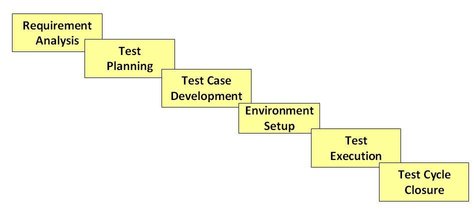
1. Requirement Analysis
During this phase of STLC, QA Team analyze and study the requirements. Have brainstorming sessions with other teams and try to find out whether the requirements are testable or not. This phase helps to identify the scope of the testing. If any feature is not testable, communicate it during this phase so that the mitigation strategy can be planned.
Activities in Requirement Phase Testing
- Identify types of tests to be performed.
- Gather details about testing priorities and focus.
- Prepare Requirement Traceability Matrix (RTM).
- Identify test environment details where testing is supposed to be carried out.
- Automation feasibility analysis (if required).
Deliverable of Requirement Phase Testing
- RTM
- Automation feasibility report. (if applicable)
2. Test Planning
Test Team plans the strategy and approach.
Test Planning Activities
- Preparation of test plan/strategy document for various types of testing
- Test tool selection
- Test effort estimation
- Resource planning and determining roles and responsibilities.
- Training requirement
Deliverable of Test Planning
- Test plan /strategy document.
- Effort estimation document.
3. Test Case Development
Develop the test cases based on scope and criteria’s.
Test Case Development Activities
- Create test cases, automation scripts (if applicable)
- Review and baseline test cases and scripts
- Create test data (If Test Environment is available)
Deliverable of Test Case Development
- Test cases/scripts
- Test data
4. Test Environment Setup
Test Environment Setup decides the software and hardware conditions under which a product is tested. Test team may not be involved in this activity if the development team provides the test environment. The test team is required to do a smoke testing of the given environment.
Test Environment Setup Activities
- Understand the required architecture, environment set-up and prepare hardware and software requirement list for the Test Environment.
- Setup test Environment and test data
- Perform smoke test on the build
Deliverable of Test Environment Setup
- Environment ready with test data set up
- Smoke Test Results.
5. Test Execution Phase
Real-time validation of product and finding bugs.
Test Execution Activities
- Execute tests as per plan
- Document test results, and log defects for failed cases
- Map defects to test cases in RTM
- Retest the resolved issues
- Track the defects
Deliverable of Test Execution
- Completed RTM with the execution status
- Test cases updated with results
- Defect reports
6. Test Closure
Once testing is completed, matrix, reports, results are documented.
Test Cycle Closure Activities
- Evaluate cycle completion criteria based on Time, Test coverage, Cost,Software, Critical Business Objectives, Quality
- Prepare test metrics based on the above parameters.
- Document the learning out of the project
- Prepare Test closure report
- Qualitative and quantitative reporting of quality of the work product to the customer.
- Test result analysis to find out the defect distribution by type and severity.
Deliverable of Test Cycle Closure
- Test Closure report
- Test metrics
What is Entry and Exit Criteria in STLC?
- Entry Criteria: Entry Criteria gives the prerequisite items that must be completed before testing can begin.
- Exit Criteria: Exit Criteria defines the items that must be completed before testing can be concluded
 Automation Testing Lab